
Written by the Janitva IVF team · Medically reviewed by Dr. Arpita Sarmah, MBBS, MD. (Obs & Gyn), Fellowship in ART · Last updated June 2026
A few years ago, if a woman in Guwahati wanted to freeze her eggs, the honest answer was “you’ll probably have to travel to Delhi or Mumbai.” That’s changed. The technology is here in Assam now, and one of the first questions every woman asks is the practical one: what is this going to cost me?
It’s a fair question, and the internet gives frustratingly vague answers. So let’s be specific and honest about the money — what a cycle includes, what gets billed later, the realistic ranges, and how to plan for it without losing sleep. (For Janitva’s exact current figures, see egg freezing at Janitva IVF in Guwahati; this post is here to help you understand those numbers first.)
Table of Contents
ToggleThe honest headline number
Across India, one egg-freezing cycle typically costs somewhere between ₹1,00,000 and ₹2,50,000, with most clinics landing in the ₹1.35–1.75 lakh range. The big swing is mostly down to the cost of your stimulation medicines, which vary from person to person. In a tier-2 city like Guwahati, prices generally sit at the friendlier end of that national range rather than the metro top end.
But here’s the part the headline number hides: that figure is for freezing the eggs. It isn’t the full lifetime cost, because there are two more bills waiting down the line. Let’s walk through all of it so nothing surprises you.
What one egg-freezing cycle actually includes
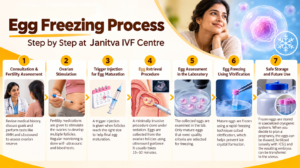
A complete egg-freezing cycle usually covers:
- Your first consultation and the ovarian-reserve tests (an AMH blood test and a scan to count your follicles).
- The hormone injections that stimulate your ovaries to grow several eggs in one cycle.
- The monitoring scans and blood tests during those couple of weeks.
- The egg-retrieval procedure itself, done under light sedation.
- Freezing the eggs by vitrification (flash-freezing), plus the first year of storage.
That’s the cycle. If you want to picture exactly what each of these feels like day to day, what the process actually involves walks through it. Now, the costs that come after.
The costs that come later (and catch people out)
Yearly storage
Your eggs sit in specialised cryo-storage tanks, and that costs money every year after the first. Annual storage in India typically runs ₹10,000 to ₹30,000 a year. It’s not huge, but it’s ongoing — if you freeze at 31 and use them at 37, that’s six years of storage fees to factor in.
The cost of actually using your eggs
This is the one most people forget. Frozen eggs don’t become a baby on their own. When you’re ready, they have to be thawed, fertilised with sperm in the lab (usually by ICSI), grown into embryos, and transferred to your womb. That’s essentially an IVF cycle, and it carries its own cost when the time comes — roughly another ₹1 to 1.75 lakh. Freezing buys you the option; using it is a separate, later investment.
More than one cycle
Younger women with a good egg reserve can often bank enough eggs in a single cycle. But if you’re a little older, or your AMH is on the lower side, your doctor may suggest two or even three cycles to collect a safe number of eggs — and each cycle is its own cost. This is one of the strongest financial arguments for not waiting too long, which is exactly why the best age to freeze your eggs matters as much to your wallet as to your odds.
Typical egg freezing costs in Guwahati (2026)
Here are realistic ranges to plan around. These are general Guwahati/India ranges, not a specific quote — your actual cost depends on your medicines and how many cycles you need.
| Item | Typical range (Guwahati / India, 2026) |
|---|---|
| One egg-freezing cycle (stimulation, retrieval, vitrification, first-year storage) | ₹1,00,000 – ₹1,75,000 |
| Stimulation medicines (the big variable; sometimes billed separately) | ₹30,000 – ₹80,000 |
| Annual storage (per year, after year one) | ₹10,000 – ₹30,000 |
| Using your eggs later (thaw + ICSI + embryo transfer) | ₹1,00,000 – ₹1,75,000 (a future IVF cycle) |
Why your quote might differ from your friend’s
If a friend paid less, it usually comes down to three honest reasons, not one clinic ripping anyone off:
- Medicines. Your dose depends on your age and ovarian reserve. Two women can have very different medicine bills for the “same” cycle.
- What’s bundled. One clinic’s “₹1.2 lakh” may exclude storage or medicines that another clinic’s “₹1.6 lakh” includes. Always ask what’s in and what’s extra.
- Number of eggs and cycles. Banking a safe number of eggs may take one cycle for one woman and two for another.
So when you compare clinics, don’t compare the sticker price — compare what each price includes. As ASRM and other fertility bodies stress, this is an established option, though never a guarantee, and a clinic worth trusting will lay the costs out plainly.
Does insurance cover egg freezing in India?
Mostly, no. Egg freezing for personal or “social” reasons (delaying motherhood for career, study, or because the right time hasn’t come) is treated as elective, and most Indian health policies don’t cover elective fertility preservation. The usual exception is medical egg freezing — for example, before cancer treatment that could harm fertility — where some policies may help. Check your own policy’s fine print, and ask the clinic’s counsellor what, if anything, is claimable.
How to budget for it sensibly
Three simple moves take the panic out of the number:
- Ask for an all-in written estimate that names the likely medicine cost for your protocol and spells out what’s extra.
- Budget for the future use, not just the freeze. Mentally set aside that you’ll one day pay for thawing and an IVF cycle too. If you never use the eggs, you’ve lost only the storage fees; if you do, you won’t be blindsided.
- Ask about EMI. Many clinics, including ours, offer instalment options that spread the cost into manageable monthly payments.
When you want real figures for your situation, the team behind egg freezing at Janitva IVF in Guwahati will give you an honest, itemised estimate — and tell you straight whether a second cycle is likely for you.
Frequently Asked Questions (FAQ)
One cycle typically falls in the ₹1–1.75 lakh range, with medicines being the main variable. Remember to budget separately for yearly storage and for the future IVF cycle when you use the eggs.
Usually the first year is included, then you pay an annual storage fee of roughly ₹10,000–₹30,000. Always confirm what's included before you sign up.
No. Freezing and using are two separate costs. Using your eggs later means thawing, fertilising with sperm (ICSI) and an embryo transfer — essentially a future IVF cycle.
Tier-2 cities generally have lower clinic and overhead costs, so prices tend to sit below metro rates for the same standard of care.
It depends on your age and egg reserve. Younger women often manage in one; older women or those with a lower reserve may need two or three to bank a safe number of eggs.