
Written by the Janitva IVF team · Medically reviewed by Dr. Arpita Sarmah, MBBS, MD. (Obs & Gyn), Fellowship in ART · Last updated June 2026
This is the question almost every woman asks the moment she starts thinking about egg freezing — and it’s the right question, because timing is the single thing that most decides whether this works for you later. The trouble is that the honest answer and the convenient answer aren’t quite the same, and a lot of marketing blurs the two. So let’s separate them clearly.
Table of Contents
ToggleThe short answer (and the honest catch)
Biologically, the best window to freeze your eggs is your mid-20s to early 30s — and ideally before 35. That’s when your eggs are at their best in both number and quality, so you need fewer of them and fewer cycles to give yourself a strong chance later.
Here’s the honest catch: most women don’t think about egg freezing in their mid-20s. They think about it at 33, 35, even 38 — when a relationship hasn’t worked out the way they hoped, or a career is finally settling, or a doctor mentions a low egg reserve. So the practical question isn’t really “what’s the perfect age?” It’s “given where I am right now, is freezing still worth it for me?” For many women, the answer is yes — it’s just important to go in with clear eyes about what your age means.
Why age matters so much: it’s about quality, not just quantity
Every woman is born with all the eggs she’ll ever have, and that number falls steadily over the years. But the bigger issue isn’t only how many eggs you have left — it’s how many are genetically healthy.
The proportion of healthy (chromosomally normal) eggs drops as you age. Roughly speaking, in your late 20s a large share of your eggs are normal; by your late 30s that share has fallen well below half; and after 40 it drops steeply. This is why a 41-year-old can’t simply “make up for it” by freezing more eggs — a bigger pile of lower-quality eggs doesn’t equal a younger woman’s smaller pile of healthier ones. Freezing earlier means you’re banking better eggs, which also means a lower miscarriage risk when you eventually use them.
How many eggs you’ll need — and how that changes with age
Egg freezing is partly a numbers game: you want enough good eggs banked that, after the inevitable losses along the way (not every egg survives thawing, fertilises, or becomes a healthy embryo), you still have a realistic shot at a baby.
As a rough guide to having a good chance — think around a 70% shot — of at least one live birth, fertility research points to ballpark targets like these:
| Age at freezing | Rough number of mature eggs to aim for |
|---|---|
| Under 35 | ~10–15 |
| 35–37 | ~15–20 |
| 38–40 | ~20–30 (often needs more than one cycle) |
| 42+ | 40+ (frequently impractical) |
Notice the pattern: the older you are, the more eggs you need and the fewer you tend to produce per cycle — so older women often need several cycles to reach a safe number, which also affects what it costs. A woman under 35 with a healthy reserve can sometimes get there in one cycle. That’s the quiet advantage of starting earlier.
So is 35 too late? Is 38?
No, 35 is not too late. It’s just no longer the ideal — you’re slightly past the peak, but freezing in your mid-30s still gives plenty of women a genuine future option, especially with a couple of cycles.
By 38, the picture shifts more sharply. Fertility bodies generally find the chance of success is highest when eggs are frozen before the mid-30s, and many specialists are cautious about recommending egg freezing for age-related reasons much past 38, simply because the returns diminish and the egg numbers needed climb fast. That doesn’t mean it’s impossible after 38 — it means you need a frank, individual conversation about your own reserve and realistic expectations before spending the money.
The most useful thing you can do at any age is get your ovarian reserve checked (a simple AMH blood test and a follicle scan). Your numbers — not a generic age bracket — tell you where you actually stand.
What the law says in India (the 21–50 window)
Beyond biology, there’s the legal side, and India has clear rules here. Under the country’s ART (Regulation) Act — the law that governs fertility treatment — a woman can access ART services, including freezing her own eggs, generally between the ages of 21 and 50. The clinic must be officially ART-registered, and the process requires written consent and counselling beforehand.
One important and welcome point: single women — unmarried, divorced or widowed — are legally allowed to freeze their eggs in India. You don’t need to be married, and you don’t need a partner. This matters, because for many women the whole reason to freeze is precisely that they haven’t met the right person yet and want to keep the door open. (Laws carry nuances and can be updated, so confirm the current rules with your clinic — but the headline is that this is legal and available to you.)
The real-life tension: best age vs. when people actually do it
Let me be straight, because I think honesty serves you better than a tidy slogan. The medically ideal age to freeze is younger than the age at which most women feel ready, financially or emotionally, to do it. Studies of women who freeze eggs put the average age at around 37 — comfortably past the biological sweet spot.
That gap is real, and it’s nobody’s fault. Life rarely lines up neatly with biology. The point of knowing it isn’t to feel bad about your age; it’s to make two practical decisions sooner rather than later: get your reserve tested now (it’s cheap and quick), and if you’re going to freeze, don’t keep postponing it by another year “until things settle,” because every year nudges your odds down and your egg count up.
Who should seriously consider it now
It’s worth a proper conversation soon if you:
- are in your late 20s or 30s and not ready to have children yet, but think you’ll want them later;
- are single and want to take age off the table while you look for the right partner;
- have been told you have a low ovarian reserve or a low AMH;
- have a condition like endometriosis, or a family history of early menopause;
- are about to start medical treatment (such as chemotherapy) that could harm your fertility.
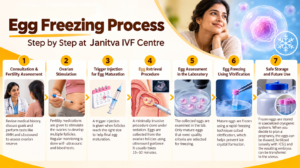
If any of those sound like you, the next step is simply a check of your reserve and a clear-eyed chat about your numbers. You can do all of that through Janitva’s egg freezing programme in Guwahati — and if you want to know exactly what you’d be signing up for, here’s how a cycle works.
Frequently Asked Questions (FAQ)
Biologically, mid-20s to early 30s, and ideally before 35 — that's when egg quality and quantity are highest, so you need fewer eggs and fewer cycles.
No. It's past the ideal but still a reasonable time to freeze, often with a strong future chance — especially with more than one cycle. Get your ovarian reserve tested to know your personal odds.
It's allowed by law (up to 50 in India), but success rates fall steeply and you'd likely need many eggs across several cycles. You need an honest, individual assessment before deciding.
Under the ART (Regulation) Act, women can generally access ART services, including egg freezing, between 21 and 50, at an officially registered clinic. Confirm current rules with your clinic.
Yes. Single women — unmarried, divorced or widowed — are legally permitted to freeze their eggs in India. You don't need a partner.